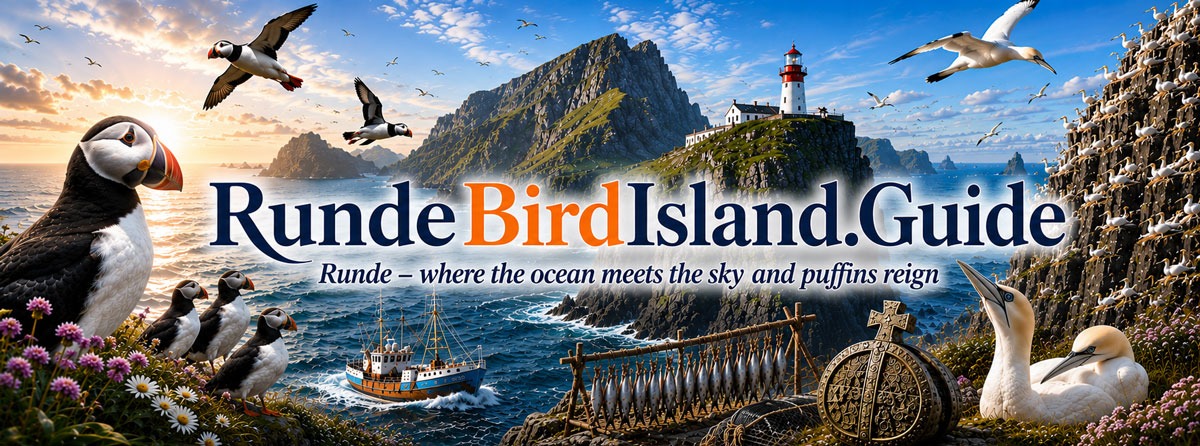
Introduction to Runde – Norway’s Bird Island
Runde is a small, dramatic island. Often called “Fugleøya” (the Bird Island), it is one of the country’s most important and accessible seabird colonies and a true gem for nature lovers, birdwatchers, and hikers.
Location:
Runde is a small island in Herøy Municipality, Møre og Romsdal county, on the western coast of Norway (Sunnmøre region). It lies at the outermost edge of the Norwegian mainland, where the fjords meet the open Atlantic Ocean.
- Coordinates: Approximately 62°24′N 5°37′E.
- It is Norway’s southernmost major seabird cliff and is positioned just north of Stadtlandet.
- The island is connected by the Runde Bridge to the neighbouring island of Remøya to the south, and from there by road and causeways to the mainland. It is roughly 30–40 km southwest of Ålesund.
Size:
- Area: 6.2 km² (about 2.4 sq mi).
- Dimensions: Roughly 4 km long and 3.5 km wide (sometimes described as around 6 km in diameter).
- Highest point: Varden at 332 meters (1,089 ft) above sea level.
- The western side features dramatic vertical cliffs rising nearly 300 meters straight from the sea, while the eastern and northern parts are more sheltered with meadows and settlements.
Population:
- Permanent residents: Approximately 110–150 people.
- Older figures: 113 (2015), 117 (2017).
- Recent estimates commonly cite around 120–150 inhabitants.
- The small community lives mainly in the more sheltered northern and eastern parts of the island. Many residents are involved in fishing, tourism, or related services.
Despite its tiny population, Runde attracts thousands of tourists every year, especially during the seabird breeding season (April–August), making it a vibrant place in summer. The island has limited infrastructure but offers a peaceful, remote atmosphere with a strong sense of community.
The bird life on Runde:
Runde has recorded around 230 different bird species in total (including migrants, visitors, and occasional sightings). The island is primarily famous for its seabird colonies, with the main breeding activity from April to August.
Many traditional seabird populations (especially puffins, kittiwakes, guillemots, and shags) have declined dramatically over the past 30–40 years due to reduced food availability (small pelagic fish like sandeel and herring), climate change, and other pressures. In contrast, gannets and great skuas have increased.
Here’s a compiled list ordered roughly from the most well-known and iconic (star attractions for tourists) to less common or more obscure species. Numbers are approximate breeding pairs where available (they fluctuate yearly; based on SEAPOP, Runde Environmental Centre, and other monitoring data). Not every one of the 230 species has detailed population data.
Iconic seabirds (main attractions):
- Atlantic Puffin (Fratercula arctica) — The star species with its colourful beak. ~32,500–60,000+ breeding pairs (one of the largest in southern Norway). Nests in burrows on grassy slopes; best seen evenings in summer.
- Northern Gannet (Morus bassanus) — Large, elegant white birds with yellow heads; dramatic plunge-divers. ~3,000–4,000 pairs (Norway’s largest colony; increasing).
- White-tailed Eagle (Haliaeetus albicilla) — Majestic raptor, often soaring overhead. Breeds on the island (first pair in 80 years in 2010); 5–10 individuals commonly seen year-round.
- Great Skua (Stercorarius skua) — Powerful, aggressive predator; one of few regular breeding sites in southern Norway. 50–100 pairs (increasing; protects territory fiercely).
Other major cliff & seabird breeders:
- Black-legged Kittiwake (Rissa tridactyla) — Graceful cliff-nesters. Historically ~50,000–100,000 pairs; now much reduced (~400–700 pairs).
- Common Guillemot / Murre (Uria aalge) — Upright seabirds on narrow ledges. Historically up to 10,000 pairs; now under 1,000–1,500 pairs.
- Razorbill (Alca torda) — Similar to guillemots but with a deeper bill. ~300–4,000 pairs (varies by year).
- European Shag (Phalacrocorax aristotelis) — Cormorant-like with a crest. Historically up to 5,000 pairs (world’s largest at one point); now ~150–350 pairs.
- Northern Fulmar (Fulmarus glacialis) — Petrel-like glider. Historically 3,000–5,500 pairs; now very low or near-absent as breeders.
Gulls & other common species:
- Great Black-backed Gull (Larus marinus) — Large, dominant gull. Breeds year-round in smaller numbers.
- Herring Gull (Larus argentatus), Lesser Black-backed Gull (Larus fuscus), Common Gull (Larus canus) — Various breeding populations.
- Black Guillemot (Cepphus grylle) — ~40–50 pairs.
Coastal & wetland species:
- Common Eider (Somateria mollissima) — Breeds on nearby islands like Grasøya/Skjervøya.
- Oystercatcher (Haematopus ostralegus) — Common along shores.
- Common Tern (Sterna hirundo) and Arctic Tern (Sterna paradisaea) — Breed on nearby islets.
- Shelduck (Tadorna tadorna), Mallard, Greylag Goose — Seen in meadows and coastal areas.
Passerines & land birds (meadows & inland):
- Northern Wheatear (Oenanthe oenanthe)
- Ring Ouzel (Turdus torquatus)
- Meadow Pipit, Rock Pipit
- Pied Wagtail, White Wagtail
- European Stonechat, Sedge Warbler, and other small songbirds.
Rarer or occasional breeders / visitors:
- Storm Petrels (mentioned in some overviews as part of the seabird community)
- Great Black-backed Gull and other gulls in varying numbers
- Migrants and vagrants: Species like Common Cuckoo, various warblers, thrushes, raptors, and waders appear during migration seasons. eBird and local records document many rarities.
Best Ways to Experience the Birds
- Hike to the bird cliffs from Goksøyra (steep but rewarding).
- Boat tours around the island for close-up views of the cliffs from the sea.
- Peak season: Late April to August, with puffins most active in the evenings when they return to their burrows.
Runde’s Terrain: Dramatic Coastal Landscape in the Open Sea
Runde is a small, rugged island located on Norway’s western coast in Herøy Municipality, Møre og Romsdal. It covers just 6.2 km² (about 4 km long and 3.5 km wide) but packs an incredibly varied and dramatic terrain shaped by the forces of the Atlantic Ocean.
Overall Topography
The island rises steeply from the sea, with a relatively flat to gently rolling central and eastern plateau that transitions into dramatic western cliffs. The highest point is Varden at 332 meters (1,089 ft) above sea level in the southeast. Another prominent feature is Rundebranden (also called Rundefjellet), where the mountain rises almost vertically to around 294–300 meters directly from the ocean on the western side.
This creates a striking contrast: the eastern and northern parts have more habitable, sheltered areas with settlements, while the western and southwestern sides face the full force of the Atlantic with sheer, exposed cliffs.
Key Terrain Features
- Steep Bird Cliffs: The most famous element of Runde’s landscape. The western cliffs (including Lundeura and Rundebranden) are towering, rugged rock faces ideal for seabird nesting. These drop dramatically into the sea, offering nesting ledges and grassy slopes just below the plateau.
- Grassy Slopes and Plateaus: Above the cliffs lie relatively flat or gently undulating plateaus covered in lush grass, heather, and low vegetation. These areas are used by puffins for burrowing and provide excellent hiking terrain with panoramic views.
- Meadows and Wetlands: The northern part (around Goksøyra/Goksøyr) features boggy or marshy areas (Goksøyrmyrane nature reserve), sheep pastures, and greener lowlands. Small lakes and ponds dot the interior.
- Rocky Shores and Coastal Zones: The coastline varies from pebble beaches and rocky shores to vertical cliffs. The northwestern tip hosts Runde Lighthouse on Kvalneset, a more exposed rocky headland.
- Hiking Paths: Trails cross varied terrain — starting with steep, sometimes paved or stepped ascents from the north, then transitioning to boardwalks, muddy paths, and open grassy ridges. Many paths lead across the island from settlements to the cliff edges.
Geology and Character
Runde’s landscape is typical of the outer Sunnmøre coast: ancient bedrock sculpted by glaciers, waves, and wind. The island feels wild and windswept, with little tree cover — dominated by grasses, mosses, heather, and hardy coastal plants. The constant exposure to North Atlantic weather creates a raw, powerful atmosphere where the sea and sky often dominate the views.
The terrain is compact but demanding: hikes to the bird cliffs are rewarding but involve steep initial climbs (especially from Goksøyra). The open plateau offers easier walking with breathtaking 360° views of the surrounding islands, fjords, and mainland mountains stretching toward Stadt and beyond.
Runde’s combination of steep cliffs, grassy highlands, wetlands, and exposed coastline makes it a dramatic miniature of Norway’s wild west coast — perfect for hikers, birdwatchers, and anyone seeking raw natural beauty in a compact, accessible package. Always check weather conditions, stick to marked paths, and respect protected areas, especially during the breeding season.
Runde’s Nature: A Rich Coastal Ecosystem
Runde’s nature is a compact but extraordinarily diverse example of Norway’s outer Atlantic coast. The island’s rugged terrain, extreme exposure to wind and sea, and protected status have created a unique mosaic of habitats that support rich birdlife, hardy vegetation, marine life, and other wildlife. Much of the island is protected — including bird reserves, the Goksøyrmyrane Nature Reserve (a Ramsar wetland site), and other conservation areas.
Vegetation and Plant Life
Runde has no forests or tall trees due to the strong winds and salt spray. Instead, the landscape is dominated by:
- Open Heathland and Grasslands: The hillsides and plateaus are covered with heather, grasses, and low-growing coastal plants. These provide ideal burrowing grounds for puffins and nesting sites for many birds.
- Mires and Blanket Bogs: Especially in the northern part (Goksøyrmyrane Nature Reserve), extensive mires and bogs dominate. These wetlands are important for carbon storage and host specialized bog plants like cotton grass (Eriophorum spp.). The bogs have steep slopes in places (up to 25°) and are vital habitats.
- Coastal Meadows and Rocky Shores: Lush grassy areas near settlements and along the shores transition into rocky intertidal zones rich in seaweed and algae.
- Diverse Flora on Cliffs: The bird cliffs and slopes around Rundebranden support a wide range of plants and flowers, thriving in the nutrient-rich environment created by centuries of seabird guano (droppings).
The vegetation is typical of nutrient-poor, wind-exposed oceanic heath but becomes more fertile near bird colonies.
Wildlife Beyond Birds
While seabirds are the stars, Runde supports other animals:
- Marine Mammals: Seals (common and grey seals) are frequently seen along the shores and in nearby waters. Occasional sightings of whales or porpoises occur in the surrounding sea.
- Terrestrial Mammals: Sheep graze on the meadows and slopes (a traditional part of the landscape). Small rodents and other mammals are present but less prominent.
- Insects and Invertebrates: Rich intertidal life, including various shellfish, crabs, and insects that support the food web.
Marine Environment
The waters around Runde are highly productive due to the meeting of currents and upwelling. This supports:
- Abundant fish stocks (sandeel, herring, etc.), which are critical for seabirds.
- Rich kelp forests and seaweed communities along the coasts.
- Ongoing research at Runde Environmental Centre focuses on marine biology, oceanography, plankton, fish, and the links between ocean health and bird populations.
Protection and Ecology
- Large parts of Runde are designated as nature reserves and Important Bird Areas (IBA). The Goksøyrmyrane mires are part of the international Ramsar Convention on wetlands.
- Access to sensitive bird areas is restricted during the breeding season (15 March – 31 August) to protect nesting sites.
- The ecosystem is vulnerable to climate change, changes in fish stocks, and pollution. Declines in some seabird populations highlight the delicate balance.
Runde’s nature offers a powerful sense of wildness in a small package — from the wind-swept heathlands and flower-dotted cliffs to the teeming sea below. It’s a living laboratory for coastal ecology and a rewarding destination for anyone who appreciates raw, unspoiled Atlantic nature. Visitors are encouraged to stay on marked paths, respect the wildlife, and leave no trace. 🌿🐦🌊
For deeper insights, visit the exhibitions and guided tours at Runde Environmental Centre.
- Other bird islands/mountains in Norway
- Naustholmen, Lovund
- Hornøya, Vardø
- Hekkingen, Malangen, Lenvik
- Reinøy
- Hernyken, Røst
- Trenyken, Røst
- Måstadfjellet, Værøy
- Nord Fugløy